







The importance of protein in infant nutrition
Protein is essential for an infant's growth, development, and overall health. It plays a crucial role in building tissues, hormones, and enzymes that are vital for various bodily functions. Moreover, the right balance of protein in infant nutrition supports the immune system and aids in proper digestion, making it a key component of any Infant formula.
Types of milk protein: whey and casein
Milk contains two main types of protein: whey proteins and casein proteins.
1. Whey proteins remain in liquid form when milk curdles in the stomach. They are more easily digested and absorbed.
2. Casein proteins coagulate in the stomach and are digested more slowly, providing a gradual release of amino acids that can support sustained growth.
-
Understanding the whey-to-casein ratio
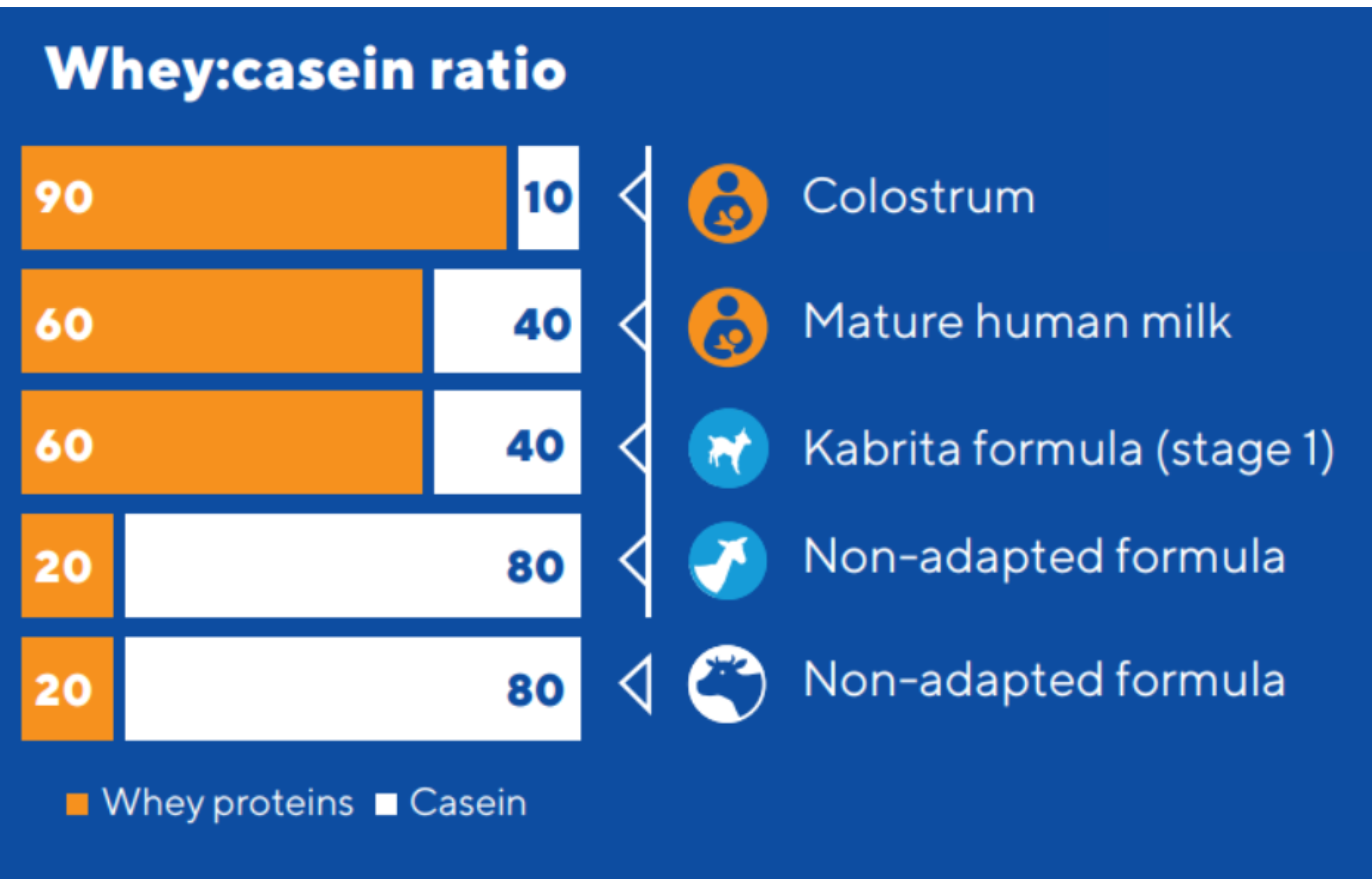
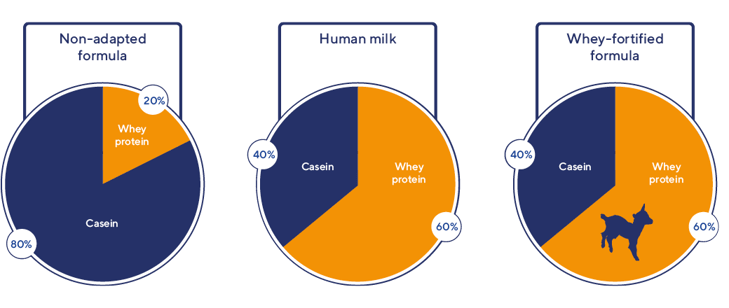
The whey-to-casein ratio describes the balance between fast- and slow-digesting milk proteins. The whey: casein ratio in human milk is around 90:10 during the first weeks after birth and decreases to 60:40 some 3-4 weeks after birth.1,4 The ratio of whey proteins and caseins in mature human milk remains around 60:40, indicating that infants have a natural need for nutrition with this whey: casein ratio of 60:40.5 Fresh goat milk has a whey: casein ratio of 20:80, like in cow’s milk.
Understanding this ratio helps healthcare professionals evaluate infant formulas and recommend options that align with digestive function and nutritional requirements.
Infant formula types: whey vs. casein
Whey-dominant formulas are generally easier to digest due to reduced protein coagulation in the stomach. For this reason, they may be suitable for infants with immature digestive systems or increased sensitivity.
Casein-heavy formulas digest more slowly due to firmer curd formation. Many modern formulas combine whey and casein to achieve a balanced protein profile, but the proportion of whey remains a key determinant of digestibility.
Benefits of Kabrita’s adapted whey-to casein ratio
To closely resemble human milk, Kabrita infant formula has an adapted whey: casein ratio of 60:40 as is the ratio naturally present in human milk. A higher proportion of whey proteins in infant formula may be beneficial as it provides higher levels of bioactive proteins such as lactoferrin, α-lactalbumin, osteopontin and immunoglobins. These bioactive proteins promotes immunomodulation and can offer protection against infections.5 Whey proteins may promote growth of beneficial bacteria in infant gut.6,7 Whey proteins are also source of amino acids
which are important for muscle synthesis. Clinical evidence suggests that whey protein has the potential to increase muscle mass, which may be beneficial for a healthy body composition in infants.17 Goat whey, and in particular β-lactoglobulin, is reported to be easier to digest than cow’s whey.2,3 Higher levels of whey proteins support in these ways a healthy development of infants.
Conclusion
During early life, infants benefit from proteins that are gentle and easy to digest, as
References
- 1. Lönnerdal, B., Nutritional and physiologic significance of human milk proteins. The American
- journal of clinical nutrition, 2003. 77(6): p. 1537S-1543S.
- 2. Park, Y.W. and G.F.W. Haenlein, Handbook of milk of non-bovine mammals. 2nd ed. 2017,
- Ames, Iowa: Blackwell Pub.
- 3. Almaas, H., et al., In vitro digestion of bovine and caprine milk by human gastric and duodenal
- enzymes. International Dairy Journal, 2006. 16(9): p. 961-968.
- 4. Kunz, C. and B. Lonnerdal, Re-evaluation of the whey protein/casein ratio of human milk.
- Acta Paediatr, 1992. 81(2): p. 107-12.
- 5. Lönnerdal, B., Bioactive Proteins in Human Milk: Health, Nutrition, and Implications for Infant
- Formulas. J Pediatr, 2016. 173 Suppl: p. S4-9.
- 6. Balmer, S.E. and B.A. Wharton, Diet and faecal flora in the newborn: breast milk and infant
- formula. Arch Dis Child, 1989. 64(12): p. 1672-7.
- 7. Hascoët, J.M., et al., Effect of formula composition on the development of infant gut microbiota.
- J Pediatr Gastroenterol Nutr, 2011. 52(6): p. 756-62.