








What every clinician counselling exhausted parents should know about sleep architecture, melatonin and milk composition in the first year.
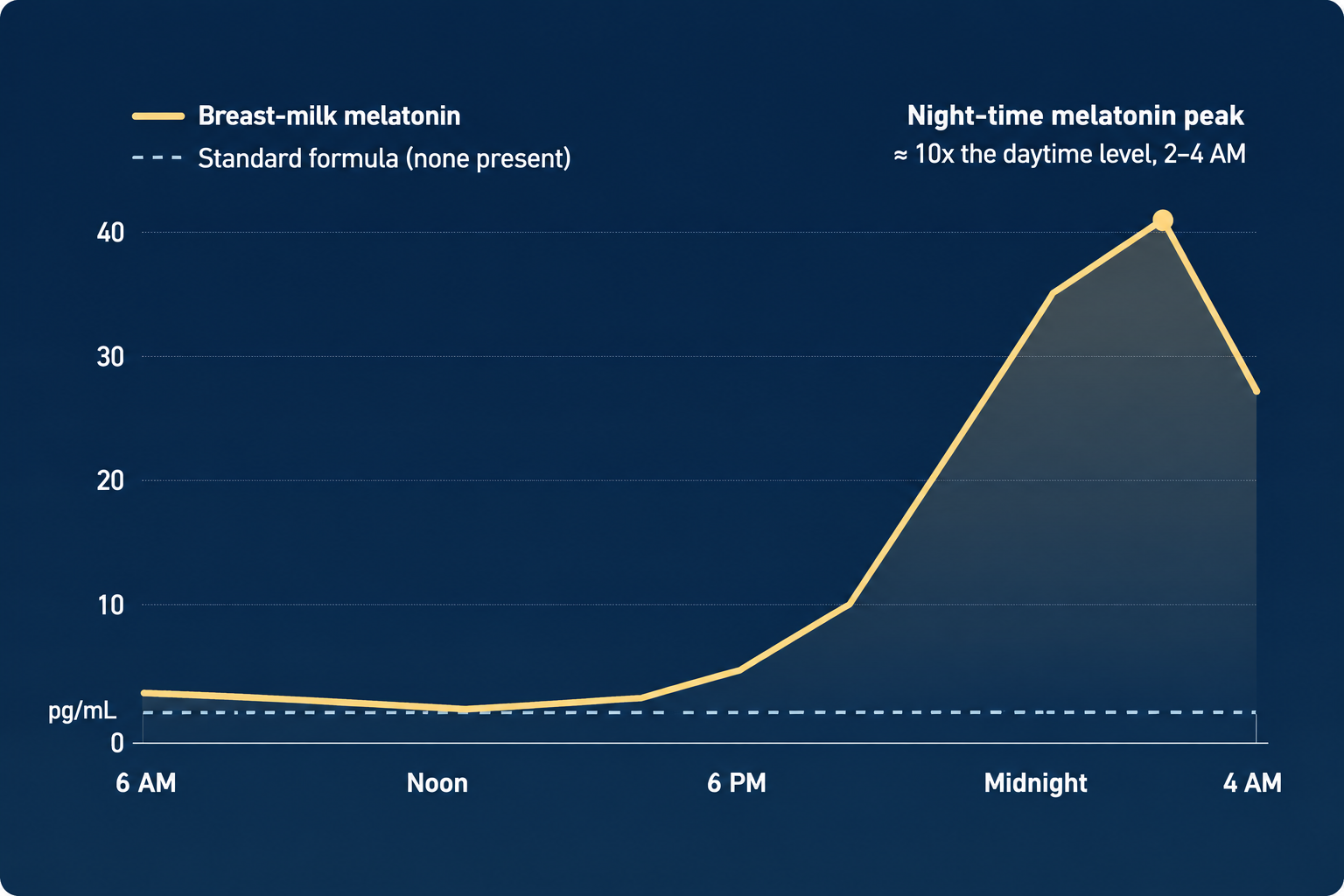
Breast milk carries a time signal. Melatonin in human milk is undetectable by day and
climbs several-fold overnight to a peak in the small hours, synchronized to the mother's own pineal rhythm. No standard formula contains melatonin. Curve drawn from pooled human lactation data.3,4,5
Ask any group of new parents what worries them most, and sleep will be at or near the top of the list. In clinic it is often the presenting complaint dressed up as something else the feed that "isn't satisfying," the reflux that "must be keeping him up," the baby who "still won't sleep through." Behind almost all of it sits a truth we don't explain often enough: waking through the night is not a fault in the baby or the parent. It is how the infant brain is built to sleep. And the thing we hand the baby several times a day, milk turns out to be one of the quiet levers on that biology.
This is a tour through what we actually know about infant sleep in the first year, and where feeding fits in: the architecture, the body clock, and the sleep-active ingredients that differ between breast milk, standard cow's-milk formula and goat-milk formula. Some of it will reassure the families you counsel. Some of it may change the advice you give.
The shape of infant sleep
Newborn sleep looks nothing like ours. A newborn spends more than half of total sleep time in REM "active" sleep, full of movement, irregular breathing and easy arousal and cycles through it roughly every 50 minutes, against the 90-odd minutes of an adult.1 Total sleep averages around fifteen hours a day, but the honest headline for parents is the range: anywhere from nine to twenty hours across the first two years falls within normal.1 There is no single "right" number.
Two things then change over the first months. The proportion of quiet, non-REM sleep rises as active sleep recedes, and slow-wave (N3) sleep the stage tied to growth-hormone release and physical development becomes more prominent.1 At the same time, the body clock switches on. Crucially, a circadian rhythm is not present at birth: sleep and wake are scattered across the full 24 hours, and it is only over the first three to six months that a day–night rhythm consolidates.1 In those early weeks the infant's clock is effectively borrowed from the mother's entrained by close physical proximity and, as we'll see, by breastfeeding itself.1
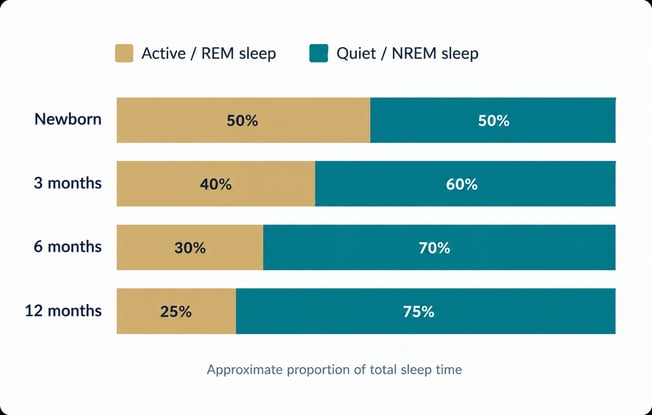
REM recedes with age. Active/REM sleep dominates in the newborn and gives way to quiet/NREM sleep across the first year the maturational shift that underlies deeper, more consolidated stretches later in infancy.1
There is a respiratory dimension to this that pediatric sleep physicians see constantly and parents rarely hear. Infants are obligate nose breathers with low functional residual capacity, and during REM sleep the loss of intercostal tone makes breathing genuinely unstable variable in rate and depth, with brief pauses.1 Periodic breathing
appears in a large share of healthy newborns, central pauses outnumber obstructive ones, and the mean apnea–hypopnea index is higher in a healthy newborn than in an older child.1 Much of what looks alarming at 3 a.m. is, in the well, thriving infant, simply immaturity of breathing control that settles with age. Knowing where that line sits normal variation versus sleep-disordered breathing that warrants investigation is exactly the judgement these families need from us.1
Counselling Point
Frequent night waking through the first year is a normal feature of an immature, still-consolidating sleep–wake system not evidence of underfeeding, insufficient milk, or a parenting failure.1,2
Milk as a time signal
Here is the part that reframes the conversation. Breast milk is not a constant. Its melatonin content follows a striking circadian curve undetectable by day and rising several-fold to a peak in the small hours, the pattern in the panel at the top of this piece.3,4,5,6 Reported night-today ratios sit around five-fold on average and reach roughly ten-fold at the 2–4 a.m. peak.4,5 A breastfed baby, in other words, receives a
chemical "it is night-time now" message with every night feed, synchronized to the mother's own pineal output. Standard formula carries none of this it is the same flat, time-blind product at every feed.
Melatonin is only the headline; the precursor pathway matters just as much. Dietary tryptophan is converted, via 5-HTP and serotonin, into melatonin and tryptophan in breast milk also peaks at night, so the raw material and the finished hormone arrive together after dark.7 Feed newborns milk formulated to follow that day–night tryptophan pattern and their sleep and melatonin metabolites shift accordingly; chrono nutrition studies using dissociated day/night formulas make the point directly.8 It's why I tell expressing mothers something that sounds fussy but isn't: label your milk by the time you expressed it, and use night milk for night feeds. Night milk and day milk are not the same thing biochemically.
Two further ingredients round out the picture. Nucleotides such as uridine and adenosine monophosphate feed into the adenosine system that builds homeostatic sleep pressure, and human-milk nucleotides have been proposed as genuine sleep inducers.9 And the fat matters: sn-2 palmitate (beta-palmitate, "OPO") is the structural fat of human milk. In a double-blind randomized trial, high-sn-2-palmitate formula reduced infant crying and improved sleep, plausibly by producing softer stools and less gut discomfort.10 The caveat is worth stating plainly, because
credibility depends on it: ESPGHAN's position is that high sn-2 palmitate may have short-term effects on stool consistency but cannot be considered essential.11 Useful, not magical.
Where goat-milk formula fits honestly
Because this is where enthusiasm tends to outrun the evidence, let me be careful with it.
Compositionally, goat-milk formula sits closer to human milk than standard cow's-milk formula on several of the axes that touch sleep. Its protein forms softer, finer curds in the stomach closer to the soft curd of breast milk which tends to mean gentler digestion and less discomfort-driven waking. Goat milk is naturally somewhat richer in tryptophan than cow's milk,12 and naturally higher in sn-2 palmitate than the vegetable-oil blends of typical cow formulas. Its oligosaccharides are structurally more similar to human-milk oligosaccharides than those of cow's milk, which is relevant to the gut–microbiome pathways increasingly linked to sleep.13 And whey-adjusted goat formulas Kabrita among them are formulated to a 60:40 whey to- casein ratio, matching mature human milk rather than the casein dominant profile of unmodified goat or cow milk; the protein-digestion kinetics of such formulas track human milk more closely than standard cow formula does.14
Evidence Check
The honest boundaries, so the science stays defensible:
-
No formula contains melatonin, and none reproduces breast milk's circadian tryptophan peak that time-of-day signal is unique to human milk.
-
The sleep evidence for goat milk specifically is compositional and inferential supported by the OPO and digestibility data above, not by head-to-head trials of goat-milk formula on infant sleep architecture, which don't yet exist.
-
Goat milk is not hypoallergenic: it is unsuitable for confirmed IgE-mediated cow's-milk protein allergy, where an extensively hydrolyzed or amino-acid formula is required.
Within those limits, goat-milk formula is a reasonable and often well tolerated
first choice when a formula is genuinely indicated and there is no IgE allergy particularly in the comfortable, colicky or sleep disturbed formula-fed infant, where softer curds and improved fat absorption plausibly ease the gut discomfort that drives so much early night waking.
The counselling truths that surprise parents
A few findings consistently land hard in clinic, because they run against intuition. The first is about mothers, not babies. Breastfeeding mothers sleep more than formula-feeding mothers, not less on the order of three-quarters of an hour more per night in one well-known study an effect attributed to prolactin's sedative action, the calming oxytocin release during nursing, and a faster return to sleep.15 So the familiar advice to "just give a bottle at night so you can rest" has the maternal evidence backwards. It is one of the few places I'll actively correct a well-meaning relative in the room.
The second is about the babies. Formula-fed infants do tend to wake less often and settle into longer stretches, and parents duly perceive "better sleep." But when sleep is measured objectively rather than reported, total sleep duration across feeding modes is very similar; what differs is sleep quality and the maturation of that circadian signalling.2,16 Fewer wakings is not the same as better sleep a distinction worth drawing gently, because it lifts the pressure off exhausted breastfeeding parents who fear they are doing something wrong.
A practical order of operations
None of this means abandoning behavioral sleep support it means
sequencing it correctly. Assess and optimize feeding first; only then do
the behavioral strategies work reliably. Graduated extinction and its
gentler variants have good randomized evidence and, importantly, no
demonstrated long-term harm at five-year follow-up.17 But hunger waking
will defeat any sleep-training plan, so the feeding question comes before the sleep-training question, every single time. And whatever the feeding mode, the safe-sleep non-negotiables don't move: back to sleep, on a firm flat surface, in the baby's own space, in a room that isn't overheated, with soft bedding kept out of the cot.18 One nuance deserves emphasis in counselling the risk profile of bedsharing is not identical across feeding modes, and is higher for formula fed infants than for breastfeeding dyads following recognized safer-sleep guidance.19
The bottom line
If there is a single message to carry back to families, it is that night waking in the first year is biology, not failure and that feeding shapes sleep in ways far more subtle than "which milk fills him up longest." Breast milk does something no formula can fully copy: it tells the baby what time it is, through melatonin, a night-time tryptophan peak, nucleotides and the mother's own hormonal rhythm. When a formula is
needed, composition genuinely matters, and goat-milk formula is compositionally the closest of the options on several of the levers that touch comfort and sleep provided we stay honest about where the evidence is strong and where it is still inferential. Optimize the feeding, protect safe sleep, and set expectations kindly. The broken nights are, more often than not, a healthy brain doing exactly what it is meant to.
Dr. Omendra Narayan
Consultant Pediatric Pulmonologist & Sleep Physician and Director of
Sleep Medicine, American Hospital Dubai. Honorary Associate Professor,
University of Sharjah. Dual UK board certification in Pediatrics and Pediatric Respiratory & Sleep Medicine, with a research focus on pediatric sleep, long-term ventilation and neuromuscular disease.
Disclosure & scope.
This article is adapted from a continuing-education lecture delivered by the author. The lecture was supported by a goat-milk formula manufacturer; all evidence cited is independently peer-reviewed and the author declares no personal financial conflict of interest. Written for healthcare professionals for educational purposes only it is not a substitute for individual clinical assessment, and feeding decisions must
rest on the needs of the individual infant and family.
References
1. Narayan O, Sinha A, Ibrahim R, Kadam S, Hill E, et al. Sleep physiology and
disorders. In: Sinha IP, Bhatt JM, Cleator A, Wallace H, eds. Respiratory Diseases of
the Newborn Infant (ERS Monograph). Sheffield: European Respiratory Society;
2021. pp. 273–286. https://doi.org/10.1183/2312508X.10014920
2. Brown A, Harries V. Infant sleep and night feeding patterns during later infancy:
association with breastfeeding frequency, daytime complementary food intake, and infant weight. Breastfeed Med. 2015;10(5):246–52.
3. Illnerová H, Buresová M, Presl J. Melatonin rhythm in human milk. J Clin Endocrinol
Metab. 1993;77(3):838–41.
4. Katzer D, et al. Melatonin in human breast milk and its diurnal variation. J Hum Lact. 2016;32(4):NP105–110.
5. Qin Y, et al. Variations in melatonin levels in preterm and term human breast milk
during the first month after delivery. Sci Rep. 2019;9:17984.
6. Perdomo M, et al. The role of melatonin in infant sleep physiology. Pediatr Rev.
2021;42(2):81–9.
7. Cubero J, et al. The circadian rhythm of tryptophan in breast milk affects the
melatonin metabolite 6-sulfatoxymelatonin and sleep in newborns. Neuro
Endocrinol Lett. 2005;26(6):657–61.
8. Aparicio S, et al. Chrononutrition: use of dissociated day/night infant milk formulas
to improve the development of the wake–sleep rhythms. Nutr Neurosci. 2007;10(3 4):137–43.
9. Sánchez CL, Cubero J, Sánchez J, et al. The possible role of human milk nucleotides as sleep inducers. Nutr Neurosci. 2009;12(1):2–8.
10. Bar-Yoseph F, et al. SN2-palmitate improves crying and sleep in formula-fed infants: a double-blind randomised clinical trial. Clinics Mother Child Health. 2017;14:2.
11. Bronsky J, et al.; ESPGHAN Committee on Nutrition. Palm oil and beta-palmitate in infant formula: a position paper. J Pediatr Gastroenterol Nutr. 2019;68(5):742–60.
12. Prosser CG. Compositional and functional characteristics of goat milk and relevance as a base for infant formula. J Food Sci. 2021.
13. Van Leeuwen SS, et al. Goat-milk oligosaccharides: their diversity, quantity and
functional properties in comparison to human-milk oligosaccharides. J Agric Food
Chem. 2020;68(47):13469–85.
14. Olszewski A, et al. Protein digestion kinetics of goat-milk infant formula compared
with cow-milk formula and human milk. Nutrients. 2021;13:3260.
15. Doan T, Gardiner A, Gay CL, Lee KA. Breastfeeding increases sleep duration of new parents. J Perinat Neonatal Nurs. 2007;21(3):200–6.
16. Galbally M, et al. Breastfeeding and infant sleep patterns: an Australian population study. J Paediatr Child Health. 2013;49(2):E147–52.
17. Price AMH, Wake M, Ukoumunne OC, Hiscock H. Five-year follow-up of harms and benefits of behavioral infant sleep intervention: randomized trial. Pediatrics.
2012;130(4):643–51.
18. American Academy of Pediatrics (Moon RY, et al.). Sleep-related infant deaths:
updated 2022 recommendations for reducing infant deaths in the sleep
environment. Pediatrics. 2022;150(1):e2022057990.
19. World Health Organization / UNICEF. Baby-Friendly Hospital Initiative: revised,
updated and expanded for integrated care. Geneva: WHO; 2009.